





The New Era of Revenue Growth: Meet the Predictive Revenue System
Published:


The impossible mandate
Revenue leaders are forced to make billion-dollar bets with fragmented data.
No other function in the enterprise would accept that mandate. Yet, revenue continues to run on delayed reports, outdated forecasts, and instinct. The phrase “inflection point” is overused in tech, but here it’s real. We are at the moment where the way revenue is managed — and the systems behind it — must fundamentally change.
74% of CEOs expect AI to have the most significant impact on their business, compared to only 3% for CRM.
For decades, CRM has been the broken, painful backbone of sales organizations. It records transactions, logs activity, and stores customer data. CRM was built to manually preserve a record of what already happened. CRM cannot predict what comes next. CRM cannot orchestrate the complex activities required to deliver consistent, predictable growth.
Selling is not a straight line. It is nonlinear, multidimensional, and profoundly human.
While there are stages to structure this business process, the underlying metadata that you need to harvest and analyze is as far away from structured as it gets. A messy web of conversations, signals, insights, and relationships.
Traditional systems have never been able to capture or synthesize this complexity. As a result, enterprise revenue has remained the least systemized business process. And leaders are left with an impossible mandate: making billion-dollar decisions on the basis of partial data and instinct.
Today, three transformative forces — advanced AI, unified data architectures, and disciplined revenue cadences — are converging to redefine what is possible.
By 2030, 80% of sales leaders will consider AI integration in sales workflows a critical factor for competitive advantage.
Companies that want to thrive must ask themselves, “How do we reimagine revenue end-to-end?”
Together, Clari + Salesloft are architecting a predictive system for revenue that, as a critical operations function, continuously anticipates revenue risk, prescribes action, and orchestrates growth.
The time to start is now. Lead in the new era — or get left behind.
The future of sales: The revenue flywheel
Revenue is the #1 most important business process. Yet, for many companies, it’s still the most fragmented and inefficient.
In 2025, Clari Labs found that only 34% of enterprises have a defined revenue framework.3 In other words, the majority are still operating without any clear, documented processes for driving predictable growth.
Meanwhile, Gartner found that, “Sellers with high AI partnership competency are 3.7 times more likely to meet quotas than sellers with lower AI partnership competency.”4
The catch is that AI only works when it’s applied to structured, codified revenue workflows, and connected to seller actions that drive value. In other words, revenue performance is no longer just based on heroic selling; it’s a function of go-to-market (GTM) design and trusted data to inform the AI.
Through 2030, agent-to-agent business models will drive a 5x increase in revenue over human-only business models.
Selling is a structured and unstructured process
Selling is often perceived as linear (stage 1 → stage 2 → stage 3 → close), but in reality, it’s nonlinear, multidimensional, and non-deterministic. CRM provides a basic structural foundation, yet selling involves human behaviors layered on top → email threads, meeting notes, CI insights, and relationship dynamics. A key challenge is capturing both the structured (pipeline stages, CRM updates) and unstructured (human signals, sentiment, interactions) and using them to contextualize and mutually enrich one another, to give revenue teams an accurate, complete picture of what actions they need to take to accomplish their goals. To do this requires greater visibility into a broader set of signals, including (but not limited to):
- Email: Day-to-day communication and activity
- Marketing automation: Prospect and customer engagement
- Conversation intelligence: Meetings and calls
- Sales enablement: Content usage and engagement
- Intent signals: Buyer research and activity
- Data intelligence: Contact and account quality
- Contracting tools: Deal finalization data
- Data infrastructure/platforms: Data lakes and proprietary insights
93% of technology providers will rely on GenAI solutions for an average 35% of their revenue growth in 2025.
Breaking revenue into atomic actions
For decades, sales leaders have relied on favored maxims and techniques — “always be closing” being perhaps the most notable — implying that win rate is the ultimate metric. But that view is dangerously narrow, focusing on the end result while ignoring the actions that actually drive those outcomes. Growth and productivity are shaped by the granular units of work that accumulate into closed/won.
AI gives us the ability to deconstruct selling into atomic actions:
- Who did what
- When they did it
- And what outcome it produced
This is the “show your work” of revenue. By aggregating and analyzing these actions, enterprises gain the blueprint for reimagining productivity and growth at scale.
From fragmented workflows to a revenue flywheel
AI allows us to break these workflows into atomic actions and connect them into a flywheel of productivity and growth:
- Rep productivity drives growth. When sellers respond faster to buyers in market, progress deals more consistently, and execute with discipline, more qualified opportunities are generated.
- Growth reinforces productivity. Larger deal sizes, faster cycles, and higher retention are wins that you can now replicate.
- The flywheel accelerates as AI continuously analyzes actions, prescribes improvements, and automates execution.
As a result, this is a self-reinforcing cycle where each win makes the next one easier to achieve. Sporadic victories become predictable, compounding growth.
Revenue AI value metrics
For boards and CEOs, revenue is not just a sales outcome — it’s a measure of capital efficiency, predictability, and enterprise value creation. Therefore, AI metrics must do more than track activity; they must show where leverage exists across the entire revenue team.
Clari Labs examined 10 million opportunities5 to discover what sets top sellers apart from their peers, and just how big the rep performance gap really is. The key findings reveal a wake-up call:
- The top 10% of reps contribute 65% of all revenue.
- The top 2% alone drive 37% of revenue.
- The bottom 50% account for just 7.6% of total revenue.
This dramatic performance gap isn’t about effort or activity levels alone — it’s about working smarter with repeatable, data-driven strategies. Top performers have discovered specific formulas that drive results through precise behavior, process, and execution patterns that remain hidden without proper analysis.
To close this gap, AI must be integrated directly into the revenue workflow in order for AI insights to be acted upon, driving ROI across both efficiency and growth use cases. It also ensures that every AI insight immediately translates into an improved action or decision.
That’s why revenue AI performance should be measured along two strategic dimensions:
- Productivity metrics: the efficiency of humans and AI agents working collaboratively, showing how resources, time, and capital are deployed and maximized.
- Growth metrics: the outcomes that compound into predictable revenue, expansion, and ultimately shareholder value.
These metrics create the governance framework for running revenue as a competitive advantage — one that continuously measures, learns, and improves.
Together, these value metrics create the business outcomes for the revenue system: one that continuously measures, learns, and improves how revenue is generated. Winning companies will move beyond tracking metrics to instrumenting every action, decision, and workflow that drives revenue growth.
Productivity metrics = efficiency
- Accounts covered / engaged
- Multi-threaded / buyers engaged
- Pipeline creation sources / cadence effectiveness
- Slip rate
- Adoption / product metrics
- Leading conversation indicators (competitive, timing, pricing, product capabilities)
- Loss and churn trends (CI driven)
- Stage conversion rates
- Sales collateral efficiency
Revenue growth metrics = $
- Pipeline creation / coverage
- Deal count
- Deal size
- Account / territory / product growth
- Retention
- Expansion
- Revenue closed/won
- Deal cycle length
- Win rate / renewal rate
It starts with Revenue ContextTM
Last year, enterprises spent $13.8 billion on AI initiatives. Yet, 67% of revenue leaders6 still don’t trust the revenue data those systems rely on.
Gartner research reveals the scale of the problem: “sellers spend an average of 25 hours per week on activities that could be delegated, automated, or simplified.”7 That’s more than half their workweek lost to tasks that don’t directly drive revenue.
Meanwhile, leaders can’t get clear answers to the most fundamental questions:
- What changed in this deal?
- Who followed up after the last meeting?
- Which plays actually moved the needle last quarter?
The reason many initial AI for revenue pilots are failing? Most AI wasn’t built with Revenue Context, which is the relationship between data and outcomes and how revenue is truly created or lost. This context is fueled by signal visibility and acquiring and activating more of the right type of data — that is, the data that positively correlates to driving the best outcomes. Without that context, AI produces vague suggestions, misfires on next steps, and fails to transform those 25 hours into productive selling time.
AI without revenue context cannot deliver predictable growth across marketing, sales, customer success, and finance. Revenue context is the foundation that makes AI useful — systematically capturing who did what, when, and what outcome it led to.
This is the real differentiator. Not just documenting activities or recording outcomes, but capturing the decision-making pathways that lead to outcomes. Because rep productivity is the engine of revenue growth. When reps can increase their attainment, expand coverage, and convert at higher rates through AI that’s deeply embedded in the pulse of your business — attuned to pipeline context, customer signals, and deal risks — the impact cascades across the entire business, driving increased forecast accuracy and more predictable revenue growth.
That’s how you transform today’s productivity plateau into tomorrow’s competitive edge.
Every company sells differently
This distinction is critical. Two companies in the same category may both track opportunities, but their approaches to assembling and managing deals are fundamentally different. Effective AI must understand those differences, not gloss over them.
Simply documenting outcomes is inadequate — it ignores the logic, trade-offs, and context that drive decisions. By meticulously capturing those specific decision-making processes from first-party data, AI systems gain the granularity required to scale intelligently, replicate best practices, and optimize human revenue-generating activities across the entire organization.
Future vision: Introducing the Predictive Revenue System
For decades, revenue visibility has been treated as a luxury rather than a necessity. Leaders celebrated hitting the number, even when they couldn’t explain how they got there. Which channels worked? Which plays mattered? Which deals were at risk?
Too often, the answers were guesswork, making it nearly impossible to systematically repeat wins or optimize underperforming areas. And most companies still can’t forecast accurately several quarters out across complex sales motions, which hinders effective GTM strategy and planning.
The Predictive Revenue System changes everything. It delivers revenue visibility — the ability to see every human and machine interaction across the entire go-to-market motion, in real time. For the first time, leadership teams can move beyond hope-based forecasting to truly know their revenue reality, transforming revenue generation from an art into a predictable, scalable science.
Think of it as GPS for revenue: Just as GPS revolutionized navigation by providing real-time positioning and turn-by-turn guidance, the Predictive Revenue System transforms how organizations navigate their path to revenue. Every interaction becomes a data point, every touchpoint a coordinate on the revenue map.
The parallel to GPS extends beyond mere tracking. The Predictive Revenue System (PRS) doesn’t just show you current revenue health; it captures the broadest set of signals that feed the AI forecast model to predict future outcomes and prescribe the best actions to reach your targets — directly in the sales workflow. It identifies the fastest routes to close deals, warns of potential roadblocks before they materialize, and continuously recalibrates based on real-time market conditions and buyer behavior patterns.
Why the predictive revenue system will flourish on the foundation of CRM
The fundamental limitation of CRM becomes clear when viewed through this lens. CRM is reactive, capturing what someone thinks happened after the fact, often filtered through human memory and bias. PRS is proactive, autonomously recording what actually happened in real-time and using that data to predict what will happen next.
CRM depends on manual entry and rep compliance, creating gaps and inconsistencies that compound over time. PRS is autonomous, operating as an always-on system that captures every interaction without human intervention. In short: CRM is the filing cabinet — a static repository for storing information. PRS is the operating system — the intelligent infrastructure that processes, analyzes, and acts on information to drive outcomes.
While CRM and other technologies help you understand what happened last quarter (or on the last call), PRS tells you what will happen several quarters in the future and what exactly you should do about it.
The core ingredients
The power of Predictive Revenue System emerges from the convergence of three critical components, each amplifying the others to create capabilities that exceed the sum of their parts.
- The Revenue Engine serves as the real-time mechanism that captures, synchronizes, and analyzes every interaction across the entire revenue ecosystem. This is built on the foundation of CRM. Think of it as the intelligence foundation, the nervous system of your revenue organization — a sophisticated infrastructure that connects every touchpoint, conversation, and decision into a unified, intelligent network. This engine doesn’t just store data; it processes relationships, identifies patterns, and maintains context across complex, multi-stakeholder buying journeys that can span months or years.
- Agentic AI represents the cognitive layer that watches, listens, learns, and then acts with precision at superhuman speed. This isn’t about passive analytics or simple automation. For example, intelligent revenue agents identify winning patterns before they become obvious, spotting risks while there’s still time to mitigate them, and guiding sellers and leaders with recommendations tailored to specific contexts and objectives.
AI informed by Revenue Context continuously evolves, becoming smarter with every interaction and more valuable with every decision it influences. The convergence of these ingredients creates something entirely new. However, realizing this vision requires changes to revenue data management and urgent upgrades to data architecture.
Why now?
- Open APIs and system interoperability have finally matured.
- CIOs are waking up to revenue as their next frontier of accountability.
- Generative AI is ready, but it requires the right foundation to be effective.
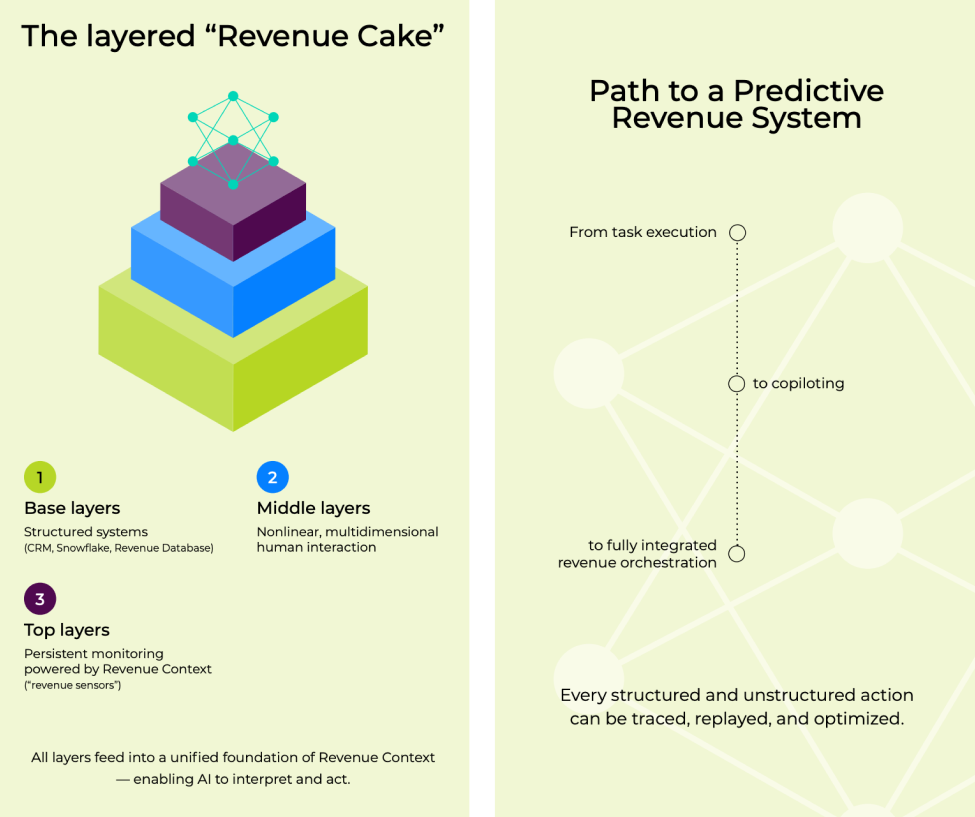
A Revenue Engine to power the system
CIOs + CROs turn AI agents into revenue-generating experts
According to Gartner, “through 2030, agent-to-agent business models will drive a 5x increase in revenue over human-only business models.”9
To get there, modern companies need a revenue engine to unify the data, systems and workflows, that power execution by connecting every revenue-critical process. The cornerstone of the engine is the ability to aggregate and analyze the broadest set of structured and unstructured data.
Time-aware model of revenue performance
The Revenue Engine integrates signals across the entire GTM stack — CRM, data infrastructure, conversation intelligence tools, email, and more — creating a time-aware model of revenue performance. It creates full-funnel, multidimensional visibility across reps, regions, segments, product lines, and motions — giving both humans and AI the context to replay, interpret, and optimize every revenue moment.
From frontline execution to boardroom QBRs, this engine becomes the control system that revenue has always lacked.
CIOs are now accountable for revenue growth
According to Gartner, “over 80% of CIOs polled in the 2025 CIO and Technology Executive Survey said they expect to increase their investments in 2025 in strong foundational capabilities and technologies such as cybersecurity, AI/GenAI, business intelligence and data analytics, or integration technologies/APIs.”10 And as more CIOs become accountable for revenue growth, this engine gives them the capability to monitor, govern, and orchestrate execution at scale — just as they do with security, infrastructure, and IT operations.
Data fragmentation becomes a unified model leveraging the broadest set of signals, including engagement history and integrations with data warehouses. Once a unified picture of data is assembled, Revenue Context ensures AI agents operate within enterprise data access rules and security standards, making seller workflows compliant seller workflows are compliant (e.g., aligned with data & security policy) and adhering to AI ethics and responsibility standards.
What the future of selling looks like
Examples of what the future of selling will look like in the next 12-18 months:
Revenue playback
Rather than requiring sales reps to manually compile quarterly business review (QBR) presentations, which often take weeks to put together, the system delivers a comprehensive “Revenue Playback” functionality through AI agents trained on both structured and unstructured signals over time.
This enables CROs to automatically replay exactly how their all-star reps achieved their results. This capability transforms what currently demands three weeks of QBR prep across most organizations into a streamlined process that can be completed in just one day.
Deal autonomy
With enough Revenue Context, AI will eventually automate 90% of the manual work across create, convert, close, and retain — surfacing risk, guiding action, and triggering plays.
With multiple AI agents in play, orchestration will be critical: Agents must cooperate with one another to plan and action multistep processes, choreograph sequences of steps within those processes, share data and generated outputs, and resolve any conflicting next best action recommendations.
Lead in the new era. or get left behind.
Together with our customers, we will end the days where revenue decisions are made in the dark, AI and humans operate blindly, and execution is driven by gut feel instead of grounded in context. This signifies the beginning of a new era for enterprise revenue. It’s the beginning of the Predictive Revenue System — where humans and agents work in sync to unlock new levels of productivity and growth.
Combining the power of Clari + Salesloft has created the scale, data, and AI horsepower to make the Predictive Revenue System the new standard. This category-transforming move forms a Revenue AI powerhouse that redefines how humans and agents come together to run revenue. With thousands of revenue teams working within our platforms, we uniquely understand everything that’s happening to capture Revenue Context as we watch, listen, and understand what every human did when, and with what outcome.
The most comprehensive revenue AI data set
- Thousands of customers
- The most surface area across the 13-week revenue cadence
- The end-to-end and top-to-bottom Revenue AI solution
The combined company will deliver the broadest depth, value, and coverage by unifying all revenue teams — CMO, CCO, CIO, CRO, and front-line seller — and the jobs to be done across all functions. Together, Clari and Salesloft will offer the most comprehensive revenue workflow coverage that spans the entire revenue cycle, across every motion that drives revenue.
The market is shifting. The winners will be those who embrace the Predictive Revenue System before their competitors.
Lead in the new era. Or get left behind.
Meet with Clari + Salesloft to discuss your Revenue AI strategy.
Citations
1. Gartner Webinar, “Generative and Agentic AI’s Impact on CRM and Software Markets,” Julian Poulter, Roland Johnson, September 2025 (Webinar Accessible to Gartner clients only)
2. Gartner, “CSO Survey Insights: How AI and Other Technology Can Increase Seller Productivity,” Antra Sharma, August 29, 2024 (Report Accessible to Gartner clients only). GARTNER is a registered trademark and service mark of Gartner, Inc. and/or its affiliates in the U.S. and internationally and is used herein with permission. All rights reserved.
3. “6 Strategies for a Stronger Revenue Culture,” Clari, September, 2025
4. Gartner, “Increase Sales Productivity With an AI-Powered Seller Action Hub,” Dan Gottlieb, Adnan Zijadic, May 16, 2025 (Report Accessible to Gartner clients only)
5. “The State of Enterprise Revenue 2025: a Clari Labs Benchmark Report,” Clari, March, 2025
6. “AI Adoption in Running Enterprise Revenue,” Clari, May, 2025
7. Gartner, “How to Focus Sellers on High-Impact Activities,” Alice Walmesley, Luke Tipping, July 31, 2025 (Report Accessible to Gartner clients only)
8. Jessie Johnson, Seth Marrs, “AI Agents: What It Means For B2B Marketing, Sales, And Product,” Forrester Research, April 1, 2025
9. Gartner, “Turn AI Agents Into Revenue-Generating Experts,” Daryl Plummer, September 4, 2025 (Webinar Accessible to Gartner clients only)
10. Gartner Press Release, “Gartner Survey Reveals That Only 48% of Digital Initiatives Meet or Exceed Their Business Outcome Targets,” October 22, 2024 (Survey Accessible to Gartner clients only)